

Dr. Kwaku Aning, former Deputy Director-General of the International Atomic Energy Agency (IAEA), has called for greater investment in nuclear technology, emphasising its potential to transform Ghana’s energy, healthcare, agriculture, and industrial sectors if properly harnessed.
Delivering a public lecture at the College of Engineering, Kwame Nkrumah University of Science and Technology, Kumasi (KNUST), Dr. Aning highlighted the wide-ranging applications of nuclear technology for national development, noting that the technology goes far beyond its association with weapons.
He explained that nuclear science can support progress in energy generation, medicine, agriculture, environmental protection, industry, water resource management, and scientific research, positioning countries that adopt it strategically for industrial growth.
Dr. Aning revealed that Ghana has already completed the necessary feasibility studies under its 2015 Nuclear Power Programme roadmap aimed at establishing a nuclear power plant.
According to him, reliable electricity is critical for industrialization and economic expansion.
“If you want to industrialize, you cannot have power cuts. You need reliable energy resources,” he noted.
He added that nuclear power could strengthen Ghana’s energy security and allow the country to export electricity to neighbouring countries through the existing West African power interconnections.
In the health sector, Dr. Aning highlighted the growing use of nuclear technology in medical diagnostics and cancer treatment. He explained that advanced imaging technologies such as PET-CT scans and SPECT-CT scans enable doctors to detect tumours more accurately and produce detailed three-dimensional images for diagnosis.
He added that radiation is widely used in radiotherapy and brachytherapy to treat cancer by precisely targeting tumours with controlled radiation beams after specialists determine the exact pathway to the tumour.
However, he noted that access to treatment remains limited across the continent.
“Only about 28 African countries currently have functioning radiotherapy facilities, meaning many patients still lack access to life-saving treatment,” he said.
Touching on agriculture, Dr. Aning explained that nuclear science supports agricultural development through mutation breeding, a technique that exposes plant seeds to controlled radiation to produce improved crop varieties.
“What we do is expose the seed to radiation and then plant it to look for the specific attributes we want, such as higher yield or resistance to disease,” he explained.
He cited Ghana’s experience with cocoa research, where scientists developed disease-resistant cocoa varieties to combat viral infections that once threatened the industry.
He added that the technology can also help improve crop yields, develop salt-tolerant rice varieties for areas affected by sea-water intrusion, and reduce post-harvest losses by sterilizing food products to eliminate bacteria, fungi, and pests.
In water resource management, Dr. Aning explained that nuclear techniques using isotopes such as hydrogen, tritium, and carbon-14 can help scientists track underground water sources and determine how groundwater systems are replenished.
“We can use isotopes to determine where the water is coming from and whether the aquifer is being replenished or if it is fossil water that will not come back once used,” he said.
He warned that pollution from activities such as illegal mining and excessive chemical use could contaminate underground aquifers, which represent a significant portion of the world’s freshwater resources.
He added that nuclear techniques can also help monitor air and soil pollution and convert harmful industrial emissions into useful products such as fertilizers.
Beyond energy, health, and agriculture, Dr. Aning highlighted the role of nuclear technology in industry through non-destructive testing, which allows engineers to inspect pipelines, aircraft components, and welded structures without damaging them.
“This technology can help us inspect pipelines, aircraft parts and industrial equipment without destroying them,” he said.
Pro Vice-Chancellor, Professor David Asamoah, emphasized the potential of nuclear technology to contribute significantly to national development when applied responsibly.
“For countries like Ghana, the responsible application of nuclear technology holds immense promise for national development. Institutions such as the Ghana Atomic Energy Commission have over the years demonstrated the relevance of nuclear science in addressing critical challenges in areas such as food security, public health, and environmental sustainability,” he said.
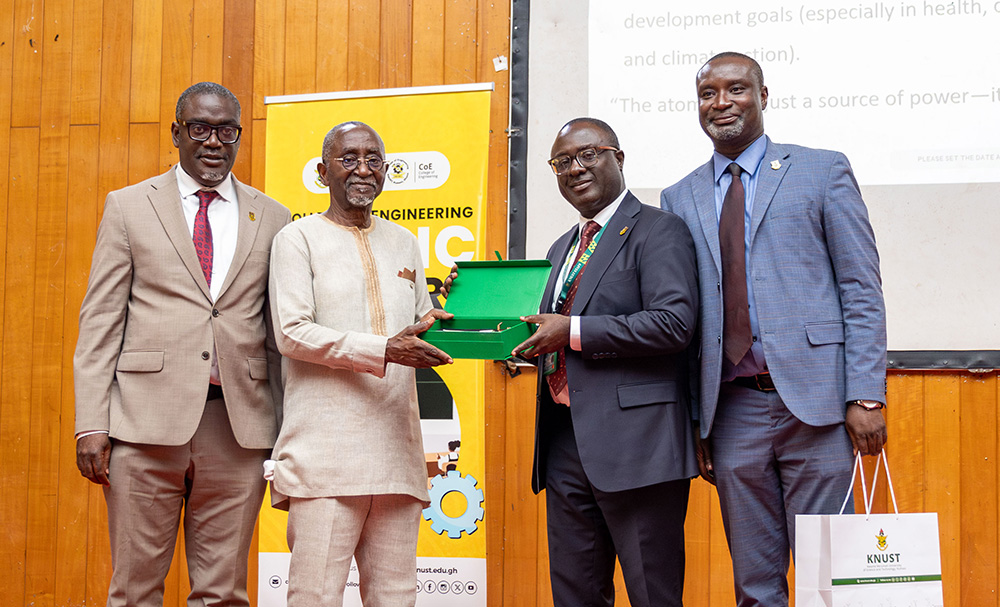
He added that KNUST remains committed to supporting research and innovation in the field.
“As a science and technology-focused university, KNUST remains committed to advancing research, innovation, and strategic partnerships that will contribute to national and global development,” he said.
By: Abena Serwaa Gyamfi Photos: Michael Kwawu


